



Introduction
Following the release of the 2026 Star Ratings in October, Medicare Advantage and Prescription Drug Plans (MA-PD) have had time to digest results that signal a pivotal shift in the industry landscape. After years of steady decline, ratings have stabilized, but meaningful improvement remains elusive. As plans navigate heightened regulatory scrutiny, evolving measure weights, and the upcoming Health Equity Index, strategic positioning for 2027 and beyond has never been more critical. The stabilization seen in 2026 represents not a return to form, but rather a new baseline from which organizations must rebuild.
2026 Star Ratings Key Observations
- 18 contracts achieved five stars in 2026, more than doubling from just 9 in 2025, though still far below the 38 contracts that earned this distinction in 2024
- Approximately 40% of plans received four or more stars, holding relatively steady but representing a dramatic compression from 68% in 2022
- 64% of MA-PD enrollees (by enrollment weight) are currently in plans rated four or more stars for 2026
- 3.66 average MA-PD Star Rating shows minimal movement from 3.65 in 2025, suggesting the multi-year decline has reached a plateau
- Notable payer divergence: While UnitedHealthcare maintained stability and Elevance saw significant gains, Humana and Aetna experienced declines in high-performing plan enrollment
- Performance stability emerges: 74% of contracts earning 4+ stars in 2025 retained their QBP status in 2026, signaling that organizations with strong operational fundamentals can maintain performance despite industry headwinds
Understanding the Stabilization: The Role of Guardrails
The relative stability observed in 2026 ratings reflects not just improved performance, but also the protective effect of CMS guardrails preventing extreme cut point volatility. These guardrails, which limit year-over-year cut point changes to 5 percentage points, had a substantial impact on 2026 results.
Analysis of guardrailed measures reveals the magnitude of protection provided to plans. Without guardrails, cut point increases would have been far more severe:
Administrative Measures Protected by Guardrails:
- Call Center TTY/FL Availability measures would have increased by 40-50 points at lower star thresholds
- MTM Program Completion Rate would have risen 24 points at the 2-star level
- Appeals measures would have increased 14-27 points across various thresholds
Clinical Measures Showing Guardrail Impact:
- Care for Older Adults measures would have increased 23-28 points without protection
- Diabetes Care – Blood Sugar Controlled would have risen 26 points at the 2-star threshold
- Complaints about the Health Plan would have dropped by 0.71 points (representing significantly harder standards)
This guardrail protection explains why some measures appear stable year-over-year despite underlying performance challenges, particularly at lower thresholds that are still reeling from Tukey outlier deletion. Plans should recognize that current cut points may not reflect true national performance trends.
The Colorectal Cancer Screening Transition: A Cautionary Tale
One of the most significant measure changes for 2026 was Colorectal Cancer Screening’s transition from hybrid (administrative + medical record) to ECDS (electronic clinical data systems) only methodology. This transition produced unexpected results that illustrate the complexity of measure specification changes.
Unlike most HEDIS measures that saw cut point increases, Colorectal Cancer Screening cut points decreased by 5 points across all star thresholds despite the methodology change being labeled as “non-substantive” by CMS. The national average star rating increased from 3.4 to 3.8, while the actual compliance rate decreased from 73% to 71%.
This counterintuitive result likely reflects several factors:
- ECDS methodology captures different data elements than hybrid approaches
- Plans with strong medical record review processes may have lost credit for documented screenings not captured electronically
- Variation in EHR documentation practices created new sources of performance dispersion
The measure’s correlation coefficient dropped from 0.90 to 0.89, suggesting slight increased variability in how plans performed year-over-year. Organizations that invested heavily in medical record retrieval for this measure may have seen unexpected declines, while those with robust EHR documentation workflows potentially gained ground.
This transition serves as an important reminder: measure specification changes can produce unpredictable results that don’t align with actual quality improvement efforts. Plans must adapt data collection and documentation strategies to align with evolving measure definitions, not just improve underlying clinical performance.
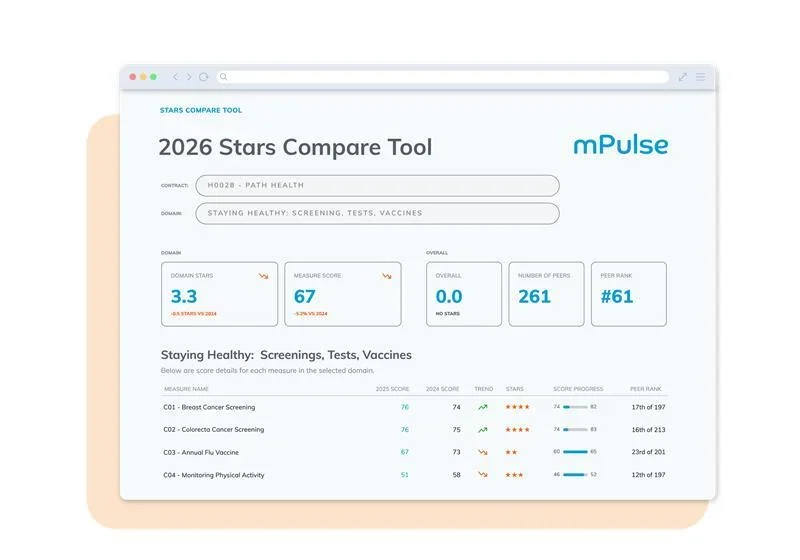
2026 Stars Compare Tool
Analyze your quality ratings and compare your performance against your peers.
2027 Star Ratings: Key Methodology Shifts on the Horizon
EHO4All Implementation
The most transformative change affecting 2027 Stars is the full implementation of the Excellent Health Outcomes for All (formerly known as the Health Equity Index Reward), replacing the existing Reward Factor. Plans will be evaluated on their performance among beneficiaries with social risk factors across specific measures. This shift fundamentally changes the economics of Stars, with top-performing plans on health equity measures positioned to gain substantial advantages while others face revenue compression.
Weight Changes Reshape Priority Measures
Building on changes initiated in 2026, several critical weight adjustments take effect for 2027:
Increased Weights:
- Improving or Maintaining Physical Health increases from 1x to 3x (returning from display page)
- Improving or Maintaining Mental Health increases from 1x to 3x (returning from display page)
New Measures Entering the Program
2027 introduces several new scored measures that expand the quality framework:
- Concurrent Use of Opioids and Benzodiazepines (COB) - addressing medication safety concerns
- Polypharmacy Use of Multiple Anticholinergic (ACH) Medications - targeting potentially inappropriate prescribing
- Care for Older Adults – Functional Status Assessment (Part C) - emphasizing comprehensive geriatric assessment
Additionally, the measure landscape includes updates to existing specifications, particularly Colorectal Cancer Screening expanding to the 45-49 age group and revisions to Diabetic Retinal Eye Exam coding.
Retired and Display Measures
Retiring Measures:
- Medication Reconciliation Post-Discharge as a standalone measure (remains part of Transitions of Care composite)
- Care for Older Adults – Pain Assessment
Moving to Display Page:
- MTM Program Completion Rate for CMR
These retirements and movements reflect CMS’s ongoing effort to reduce measure burden while maintaining focus on the most impactful quality indicators.
Looking Ahead: Strategic Imperatives for 2027 and Beyond
Medicare Advantage Market Dynamics: A Period of Recalibration
The Medicare Advantage market is experiencing a fundamental reset after years of rapid expansion. Following membership growth that added millions of beneficiaries in the early 2020s, the industry now faces enrollment contraction, plan exits, and service area reductions as payers adapt to compressed margins.
Major insurers including UnitedHealthcare, Humana, and Aetna have scaled back plan offerings for 2026, with some organizations withdrawing entirely from underperforming markets. This correction reflects the collision of multiple pressures: tightened benchmark payment rates, increased utilization patterns, elevated medical costs, and the quality rating compression that limits bonus payment eligibility.
Plans that historically relied on quality bonus payments to subsidize rich benefit designs now confront difficult choices about network adequacy, supplemental benefits, and service levels. Meanwhile, high-performing specialized plans and regional operators are gaining market share, suggesting the industry is bifurcating between organizations with operational excellence in quality management and those struggling to adapt to the new economics.
This market restructuring creates both risk and opportunity as plans that successfully navigate the transition through disciplined Stars performance, cost management, and member-centric strategies will emerge stronger, while others face continued pressure on growth and profitability.
AI Adoption in the Current Administration
The current administration has signaled strong support for AI adoption across Medicare programs, with CMS Administrator Dr. Mehmet Oz championing technology-enabled approaches to improving efficiency and reducing costs.
While the WISeR Model pilot program has drawn attention for introducing AI-assisted prior authorization to traditional Medicare, Medicare Advantage plans face a different set of AI opportunities and requirements. The Trump administration chose not to finalize proposed Biden-era guardrails for AI use in coverage determinations, instead emphasizing innovation and fraud reduction.
This regulatory posture creates latitude for plans to deploy AI tools while maintaining responsibility for equitable service delivery and compliance with coverage rules. Plans successfully leveraging AI are focusing on member engagement optimization, predictive analytics for intervention targeting, and operational efficiency rather than utilization management, recognizing that Stars performance hinges on improving outcomes and experience rather than managing costs alone.
Health Equity as Strategic Differentiator
The Excellent Health Outcomes for All Reward (EHO4All) transforms health equity from a values-based initiative to an economic imperative. Plans that have already developed robust social risk factor identification, culturally competent care coordination, and disparity reduction programs will have significant advantages in the new methodology.
Organizations without mature health equity capabilities face an urgent development timeline. Success requires cross-functional alignment, enhanced data infrastructure, community partnerships, and care team training. The most successful approaches integrate health equity considerations into every aspect of operations rather than treating it as a discrete program.
Preparing for Success
Navigating the shifting Medicare Advantage quality landscape requires more than just data. It takes strategic insight and timely action. At mPulse, we work with health plans to support smarter decision-making through advanced analytics and engagement strategies grounded in real-world outcomes.
Using Predictive Analytics and Intelligent Engagement to Guide Quality Strategy
Health plans face pressure to improve quality performance while managing limited resources. A combined approach that leverages predictive analytics and data-driven engagement is key to driving measurable impact.
The Decision Point Insights (DPI) platform provides a clearer view into population-level trends and member-level risks. With over 100 continuously enhanced predictive models, plans gain real-time visibility into performance projections and risk scoring. This enables smarter intervention targeting, resource prioritization, and long-term strategy planning.
Key capabilities include:
- Early identification of members at risk of falling short on triple-weighted measures
- Predictive scoring to prioritize interventions based on likely impact
- Real-time tracking against projected Star Rating outcomes
With this data, plans can deliver scalable, personalized, omnichannel member engagement. These programs are purpose-built for high-priority Star measures and are proven to drive results.
Documented outcomes include:
- 11.78 percentage point increase in Controlling Blood Pressure (CBP) compliance
- 7.71 percentage point increase in HbA1c control for Diabetes Care (CDC)
- 65% reduction in call attempts for post-discharge medication reconciliation
- 3.5 percentage point year-over-year improvement in Part D medication adherence
With Health Outcomes Survey (HOS) measures returning to scored status in 2026 and tripling in weight by 2027, engagement programs focused on member self-efficacy and health perception are becoming critical. mPulse’s HOS program combines predictive risk stratification with evidence-based communication strategies to improve both physical and mental health outcome—while reducing intervention costs.
Take Action: Understand Your Position and Potential
The 2026 Star Ratings represent a stabilization point after years of industry-wide decline, but stabilization does not equal success. Plans must understand their competitive position, identify improvement opportunities, and deploy evidence-based strategies to advance performance in 2027 and beyond.
Compare your 2025 and 2026 Star Ratings performance by domain using our Stars Compare Tool. This interactive resource enables side-by-side performance analysis, cut point comparison, and identification of measures where focused intervention can drive meaningful rating improvements.
Request a personalized Stars Report and strategic consultation with our quality performance experts. We’ll provide detailed analysis of your organization’s 2026 results, benchmark your performance against peers, and recommend specific strategies to optimize your 2027 trajectory.
The path to Stars excellence in this new environment requires strategic focus, operational discipline, and proven solutions. Let mPulse be your partner in navigating the complexity and achieving the results your members and organization deserve.